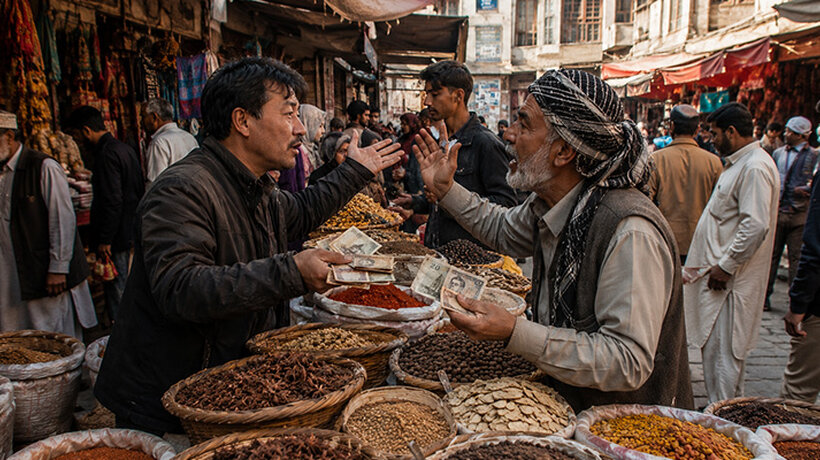
Asia Hidden on Paper Money
When Asia is mentioned, most people imagine the majestic Himalayan peaks, the endless deserts of the Arabian Peninsula, ancient temples, bustling metropolises, or the legendary Silk Road. It is a continent where some of the world's oldest civilizations emerged and where traders, rulers, scientists, and travelers from Europe, Africa, and the Far East have met for centuries.
However, we don't have to discover Asia's history only through archaeological finds or historical books. Its banknotes are a fascinating window into both the past and present. Each of them tells its own story – about rulers, religions, significant buildings, natural beauties, or the economic development of the country.
For notaphilists, Asian banknotes represent some of the most interesting collectibles in the world. They stand out with their rich colors, precise engravings, Islamic calligraphy, oriental ornaments, and modern security features. Many of them are literally small works of art.
We have selected ten banknotes that we consider to be among the most interesting not only for their appearance but also for the story of the country they come from.
🇸🇾 1. Syria – Banknote of a Country Where the First Civilizations Emerged
Banknote: 5,000 Syrian Pounds (2023)
If there is a place that can be called one of the cradles of human civilization, it is today's Syria. Trade routes passed through its territory more than four thousand years ago, and significant city-states emerged here, influencing the development of the entire Middle East.
The capital Damascus is among the oldest continuously inhabited cities in the world. Throughout history, it has been ruled by Assyrians, Babylonians, Persians, Greeks, Romans, and the Ottoman Empire. Each civilization left its legacy, which can still be admired at archaeological sites and historical monuments.
Currency History
The modern Syrian pound was introduced after the collapse of the Ottoman Empire and gradually became a symbol of an independent state. In recent decades, however, the country has been significantly affected by civil war, which has also impacted the currency's development. Higher denominations, including the 5,000-pound banknote, were issued in response to inflation.
What Does the Banknote Depict?
The banknote uses a combination of modern graphic elements and traditional Arabic ornaments. The color composition appears elegant and simultaneously represents the cultural identity of the country.
Interesting Fact
Damascus was so significant in the past that the famous Damascus steel and damask fabric were named after it.
Why Do Collectors Seek It?
It is one of the latest issues of the Syrian Central Bank. It captures a period of the country's modern history and simultaneously represents a beautiful example of contemporary banknote design in the Middle East.
🇶🇦 2. Qatar – A Desert Country Among the World's Wealthiest States
Banknote: 10 Qatari Riyals
At the beginning of the 20th century, Qatar was a country of fishermen and pearl hunters. Today, it is among the world's wealthiest states thanks to its vast reserves of natural gas and oil.
In recent decades, the capital Doha has transformed into a modern metropolis full of futuristic skyscrapers, museums, and sports facilities. This contrast between traditional Arabic culture and modern architecture is also reflected in Qatari banknotes.
Currency History
The Qatari riyal became the official currency in 1973 following a monetary reform that followed independence.
What Does the Banknote Depict?
Qatar's banknotes feature modern buildings, cultural landmarks, traditional dhow sailing boats, and delicate Islamic ornaments. The design appears very clean and elegant.
Interesting Fact
Qatari banknotes are among the most technologically secure banknotes in the Arab world. They contain holographic elements, microtext, and special security fibers.
Why Is It Interesting?
It represents the modern face of the Arab world and is among the most beautiful banknotes issued in recent years.
🇸🇦 3. Saudi Arabia – The Kingdom of the Two Holy Mosques of Islam
Banknote: 5 Saudi Riyals
Saudi Arabia holds a unique position in the Islamic world. It is home to the two holiest cities for Muslims – Mecca and Medina, which millions of pilgrims visit annually.
Besides its religious significance, the country is among the world's largest oil producers, which has significantly influenced its development during the 20th century.
Currency History
The Saudi riyal is among the stable currencies of the Middle East, and its history dates back to the establishment of the modern Saudi state in 1932.
What Does the Banknote Depict?
The banknotes feature portraits of royal family members, significant mosques, and national symbols. Delicate Islamic geometric patterns and beautiful Arabic calligraphy are not missing.
Interesting Fact
Unlike many Western countries, Saudi Arabia's banknotes bear prominent religious and cultural elements that emphasize the importance of Islam in everyday life.
Why Is It Among Favorite Banknotes?
It stands out with its exceptionally high-quality printing, harmonious colors, and rich details.
🇱🇧 4. Lebanon – The Land of Cedars and Ancient Mariners
Banknote: 50,000 Lebanese Pounds
Lebanon has been home to the Phoenicians for centuries – a nation of mariners and traders who founded numerous colonies throughout the Mediterranean and significantly influenced the development of writing and trade.
In modern history, Lebanon was considered the financial center of the Middle East, and the capital Beirut earned the nickname Paris of the Orient.
Currency History
The Lebanese pound was established during the French mandate and for decades was among the most stable currencies in the region. However, the economic crisis of recent years has significantly weakened its value.
What Does the Banknote Depict?
Dominated by historical buildings, cedar forests, and cultural landmarks, the banknote reminds us of the country's rich history.
Interesting Fact
The Lebanese cedar is one of the oldest national symbols in the world. It appears not only on the flag but also on several banknotes and coins.
Why Collect It?
It is a beautiful reminder of one of the Middle East's culturally richest countries.
🇾🇪 5. Yemen – The Land of the Legendary Incense Route
Banknote: 500 Yemeni Riyals
Yemen was already a center of trade in incense, myrrh, and precious spices in ancient times. Caravans traveled thousands of kilometers from there to Egypt, Rome, or Persia. Thanks to this trade route, the territory of today's Yemen was among the wealthiest areas of the Arabian Peninsula.
One of the country's greatest treasures is the historic city of Sana'a, with its characteristic multi-story mud-brick houses decorated with white ornaments. It is listed as a UNESCO World Heritage Site and is among the world's architectural unique sites.
Currency History
The Yemeni riyal was established after the unification of North and South Yemen in 1990. Despite the complex political development, it remains a symbol of a unified country.
What Does the Banknote Depict?
The banknotes feature historical fortresses, mosques, traditional architecture, and cultural landmarks. The color composition is based on Islamic art and local ornamental motifs.
Interesting Fact
The ancient Romans called this area Arabia Felix – "Happy Arabia," because it was among the wealthiest regions of the entire Arabian Peninsula.
Why Is It Among Interesting Banknotes?
It combines the rich history of ancient trade with unique architecture that has no parallel in the world.
🇵🇰 6. Pakistan – A Young State with a Rich Cultural Heritage
Banknote: 75 Pakistani Rupees (2022)
Pakistan is among the youngest countries in Asia. It was established on August 14, 1947, by the partition of British India and has played a significant role in South Asia since its founding. Although its modern history spans less than a century, the territory of today's Pakistan was home to one of the world's oldest civilizations – the Harappan civilization in the Indus Valley.
Today, Pakistan is a country of contrasts. In the north, some of the world's highest mountain ranges rise, including the Karakoram with the K2 peak, while the south of the country is washed by the Arabian Sea. This diversity is also reflected in modern banknotes.
Currency History
The Pakistani rupee has been in use since the state's establishment in 1947. Initially, the country used banknotes printed during the British India period, and only later began issuing its own emissions.
The commemorative banknote 75 rupees was issued on the occasion of the 75th anniversary of the country's independence and immediately attracted the attention of collectors.
What Does the Banknote Depict?
The banknote features a portrait of Pakistan's founder Muhammad Ali Jinnah along with other significant personalities. A very interesting element is also the depiction of rare Pakistani animals, including the snow leopard, markhor, and Indus River dolphin. These motifs remind us of the richness of local nature and the effort to protect it.
Interesting Fact
It is one of the few modern commemorative banknotes that combines historical figures with endangered animal motifs. Such a combination makes this emission an exceptional collectible piece.
Why Is It Among Interesting Banknotes?
It is a modern commemorative emission with an attractive design that celebrates the state's founding and simultaneously highlights the protection of natural heritage.
🇺🇿 7. Uzbekistan – The Treasure of the Legendary Silk Road
Banknote: 10,000 Sums (2021)
For centuries, Uzbekistan was one of the most significant points on the Silk Road. Caravans carrying silk, spices, porcelain, and precious stones passed through the cities of Samarkand, Bukhara, and Khiva, which became centers of learning, trade, and Islamic culture.
Even today, these cities are among the world's most beautiful historical sites and are listed as UNESCO World Heritage Sites.
Currency History
After the collapse of the Soviet Union, Uzbekistan introduced its own currency – the sum. Newer banknotes are among the most graphically successful emissions in Central Asia.
What Does the Banknote Depict?
The banknote's dominant features are the monumental buildings of Samarkand and the characteristic Islamic architecture with blue domes, mosaics, and richly decorated portals. The design is complemented by ornamental elements inspired by traditional Uzbek art.
Interesting Fact
Samarkand was once called one of the most beautiful cities in the world, and its Registan Square is among the most photographed historical places in all of Asia.
Why Collect It?
It represents a unique combination of Islamic architecture, Silk Road history, and modern banknote design.
🇹🇯 8. Tajikistan – Persian Culture Under the Peaks of the Pamirs
Banknote: 10 Somoni (2021)
Tajikistan is one of the least known countries in Central Asia, yet it is also among its most picturesque states. More than ninety percent of its territory is covered by high mountains, and the legendary Pamir Mountains are often referred to as the "roof of the world."
Unlike most neighboring countries, Tajiks are descendants of ancient Persian nations. They still speak a language related to Persian, and their culture has deep historical roots.
Currency History
The currency name somoni comes from Ismail Somoni, the founder of the Samanid dynasty, which in the 9th and 10th centuries created one of the most significant Persian empires in Central Asia.
What Does the Banknote Depict?
The banknote is dominated by a portrait of a significant historical figure, complemented by ornaments derived from Persian art. Precise engraving, subtle color transitions, and rich decorative elements make this banknote one of the most beautiful emissions in the region.
Interesting Fact
The Pamir Highway is among the highest roads in the world and is a dream route for adventurers from all over the world.
Why Is It Popular Among Collectors?
It combines rich Persian history with modern banknote design and represents a country that is still relatively undiscovered among collectors.
🇲🇾 9. Malaysia – A Tropical Country of Colors and Diversity
Banknote: 1 Ringgit (2017)
Malaysia is among the most modern states in Southeast Asia. Its territory is covered by vast tropical rainforests, mangrove coasts, and mountainous areas, which are among the biologically richest places on the planet.
The country is also known for its extraordinary cultural diversity. Malays, Chinese, Indians, and indigenous ethnic groups live side by side, which is reflected in architecture, gastronomy, and art.
Currency History
The Malaysian ringgit has been in use since 1975 and is among the region's stable currencies. Modern emissions are among the best-secured banknotes in Southeast Asia.
What Does the Banknote Depict?
The obverse features a portrait of Malaysia's first supreme ruler, Tuanku Abdul Rahman. The reverse of the banknote is adorned with motifs of the national flower hibiscus and other elements reminiscent of the country's natural wealth.
Vibrant colors, delicate lines, and modern graphic processing make this banknote one of the most attractive in the region.
Interesting Fact
Malaysia is among the countries with the greatest biodiversity in the world. It is home to orangutans, Malayan tigers, and the world's largest flower – the rafflesia.
Why Collect It?
Despite its low denomination, it is a very aesthetically processed banknote and beautifully represents modern Southeast Asia.
🇹🇭 10. Thailand – The Kingdom of Smiles on Paper Money
Banknote: 20 Baht (2017)
Thailand is one of the few Asian countries that maintained its independence during the colonial period. As a result, it preserved its own monarchy, culture, and traditions, which still play a significant role in the lives of its inhabitants.
Buddhist temples, royal palaces, and rich ornamentation make Thailand one of the most photogenic countries in Asia.
Currency History
The Thai baht is among the oldest currencies in the world still in use today. Its history goes back several centuries, and modern banknotes are among the technologically very high-quality emissions.
What Does the Banknote Depict?
The banknote features a portrait of King Maha Vajiralongkorn (Rama X.), who ascended the throne in 2016. The reverse side commemorates significant rulers of the Chakri dynasty and their contributions to the country's development.
The color composition uses green shades complemented by delicate ornaments inspired by traditional Thai art.
Interesting Fact
The Thai monarchy is among the oldest continuously functioning monarchies in the world, and its members have appeared on banknotes for decades.
Why Is It Among Favorite Banknotes?
It combines beautiful graphics, royal symbolism, and the rich history of a country that is among the most visited tourist destinations in the world.
Conclusion
Asian banknotes are much more than just a means of payment. Each of them represents a small historical document that tells the story of its country. They capture significant rulers, national heroes, architectural gems, natural wealth, and moments that have shaped the history of entire nations.
That is why they are among the most sought-after collectibles in the world. They captivate not only with their colors and precise artistic processing but also with the stories behind them. From the ancient cities of Syria through the desert monarchies of the Arabian Peninsula, the legendary Silk Road in Uzbekistan to the tropical rainforests of Malaysia – each banknote is an invitation to a journey across one of the planet's most diverse continents.
For beginner collectors, they represent a great way to explore the world through history and culture. More experienced notaphilists find in them unique emissions that complement their collection with new stories and new discoveries. And that is the charm of notaphily – each banknote has its origin, its journey, and its story. Just take it in hand and let it transport you to the country it comes from.