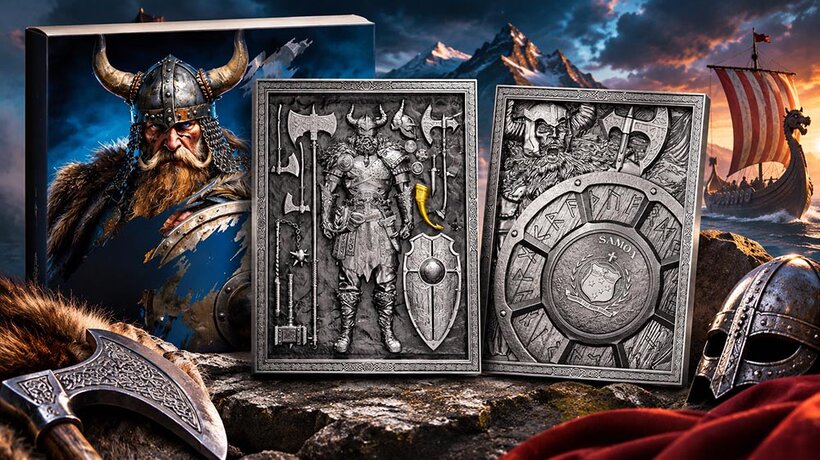
The legendary figure of Ragnar Lodbrok becomes the central motif of the third coin in the "Warriors Through Time" collection – a series that explores various historical eras through their most famous warriors. After visiting the American Wild West and the military world of ancient Sparta, the series now focuses on the Viking era. It features a 2-ounce silver coin that stands out with its high relief, "antique" finish, and selective gilding.
The collection, created by Precious Metal Collectors, features a different warrior on each coin. The warrior is surrounded by their typical weapons, armor, and iconic equipment – reminiscent of a collectible action figure displayed with all its accessories. This approach allows for a wealth of detail to be packed into a relatively small area while giving the entire series a unified character.
The rectangular format, high relief, antique finish, and exclusive focus on the collector's market place this coin within a broader trend. In this overview, we explore the key features of modern numismatics and how this field is changing the world of coin collecting.
Ragnar Lodbrok
The new coin is dedicated to Ragnar Lodbrok, one of the most famous figures in Scandinavian tradition. His personality straddles the line between history and legend, as the main accounts of his life come from sagas written centuries after the period in which he supposedly lived. For this reason, it is uncertain whether Ragnar was a real, unique Viking figure or if his identity arose from the amalgamation of deeds attributed to various Norse leaders of the 9th century.
Stories describe Ragnar as a powerful king and warrior who led expeditions against various territories in England and the Frankish Empire. He is also depicted as a descendant of ancient Scandinavian royal lines and the father of several of the most famous warriors of the Viking age, including Björn Ironside, Ivar the Boneless, Ubbe, Halfdan, and Sigurd Snake-in-the-Eye.
One of the historical events traditionally associated with Ragnar is the great Viking attack on Paris in 845. During this expedition, a fleet of many ships sailed up the Seine River, defeated the Frankish forces, and reached the city. King Charles the Bald eventually paid a high ransom to secure the attackers' departure. Contemporary sources name the leader of this expedition as Reginherus; whether this is the same person as Ragnar from the sagas remains a subject of debate among historians.
Even his death belongs more to the realm of legend. According to several medieval records, Ragnar was captured during an expedition against the Anglo-Saxon kingdom of Northumbria and executed on the orders of King Ælla, who allegedly threw him into a pit full of snakes. His last words were said to predict his sons' revenge – comparing them to young boars who would roar fiercely upon learning of their father's death. The legend continues with the arrival of the so-called "Great Heathen Army" in England – a massive Viking force that began its invasion in 865. The sagas interpret this campaign as revenge led by Ragnar's sons against those responsible for his execution. Although the true motives of the invasion were likely more complex, this story contributed to making this figure a central element of the Viking world of imagination.
Over time, Ragnar Lodbrok has gained significance far beyond the scope of medieval sources. Literature, film, video games, and – above all – contemporary television have popularized his image as an explorer, conqueror, and military leader.
DESIGN
Reverse
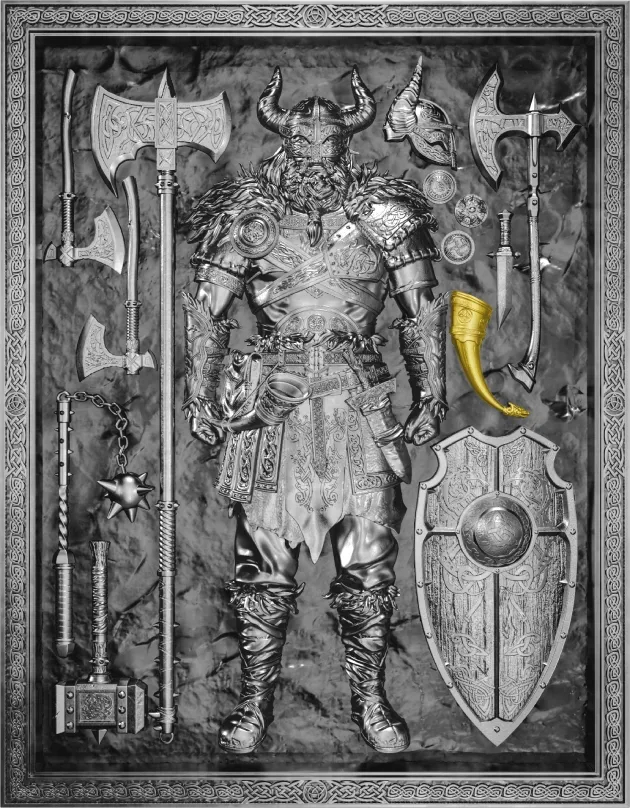
The reverse features an elaborate composition with Ragnar Lodbrok as the central element, depicted in full figure as an imposing Viking warrior. He wears richly decorated, massive armor, arm and leg guards, furs draped over his shoulders, and a helmet with two large horns.
Ragnar is surrounded by a rich arsenal of weapons – axes of various sizes, spears, hammers, a sword, a flail, and other weapons inspired by Scandinavian tradition. In the lower right part, there is also a large, elongated shield adorned with interwoven motifs.
The arrangement of these elements deliberately resembles a collectible figure displayed with its accessories. Ragnar occupies the center of the scene, while the weapons are neatly arranged around him against a stone-like background.
Among these elements, to the right of the figure, a ceremonial horn stands out, highlighted by partial gilding. Its distinctive color contrasts with the dark, silvery tones of the patinated finish, making it the main visual focal point of the entire composition.
This horn is symbolically linked to Gjallarhorn, one of the most famous objects in Norse mythology. According to myths, it belonged to the god Heimdall, who guarded the Bifröst bridge and was tasked with warning the gods of the arrival of their enemies. The sound of Gjallarhorn was said to herald the beginning of Ragnarök – the final battle that would decide the fate of the gods and the entire world.
Obverse
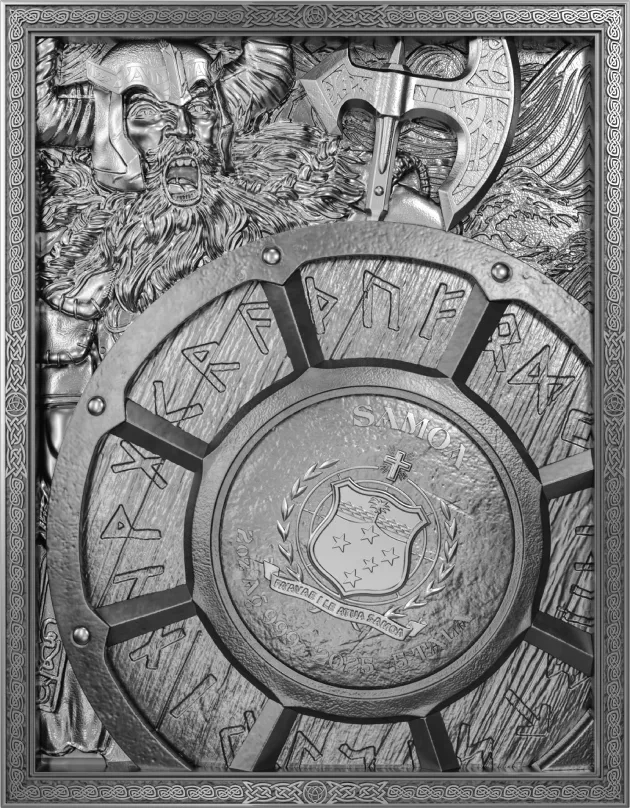
The obverse of the coin departs from static depiction and shows a battle scene, with Ragnar appearing in the background, charging into battle with a fierce expression on his face.
In the foreground, a large Viking shield dominates, adorned with runic symbols. In its center is the coat of arms of Samoa, accompanied by the inscription "SAMOA" and the text "Fa’avae i le Atua Samoa" (Samoa is founded on God).
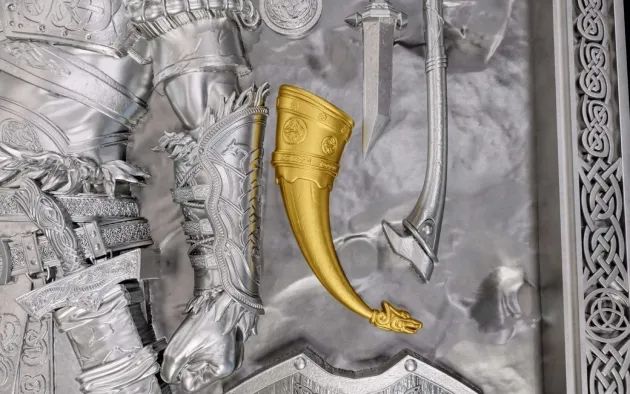
The antique finish of this coin deliberately darkens the deeper parts of the relief, highlighting the contours of figures, weapons, furs, and inscriptions. This combination gives the coin an antique appearance and allows for clear distinction of the many elements that make up its motif. The gilding of the horn also creates a visual contrast that manifests differently in each issue of this collection.
PRESENTATION
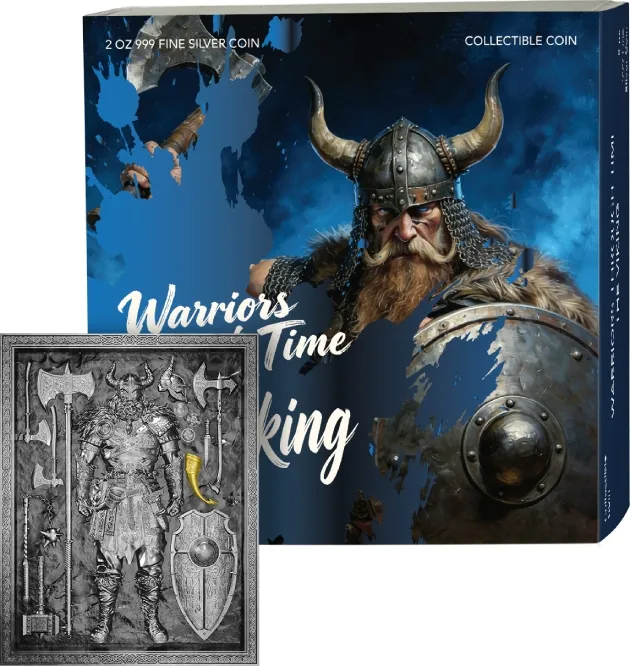
Each piece carries a unique serial number and is accompanied by a corresponding certificate of authenticity. The whole is complemented by an illustrated box featuring the image of a Viking warrior and the series title.
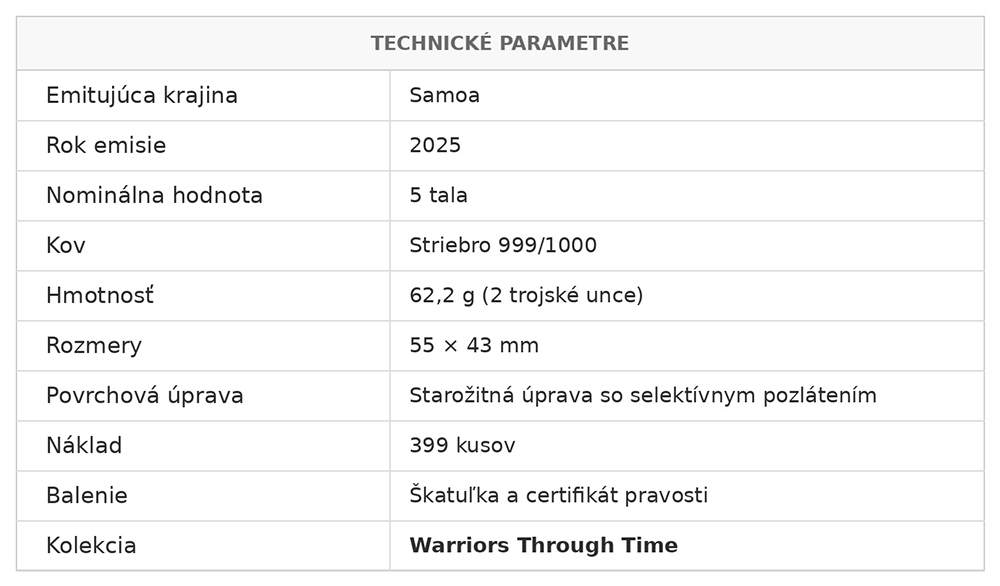
Previous coins from the "Warriors Through Time" series
Before the "Warriors Through Time" series focused on the Viking era, it brought two other coins dedicated to figures from completely different historical periods. All these coins share the same rectangular format, 2-ounce weight, "antique" finish, nominal value of 5 tala, and a limited mintage of 399 pieces.
Cowboy
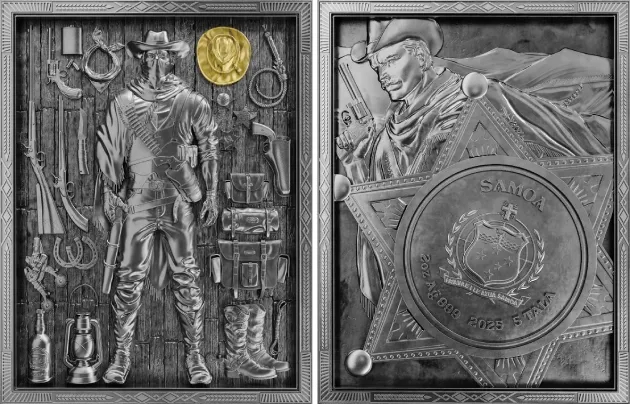
The collection opened with the "Cowboy" coin, inspired by Pat Garrett – one of the most famous figures of the American Wild West. Garrett served as sheriff in Lincoln County, New Mexico, and is best known for killing the infamous outlaw Billy the Kid in July 1881.
Spartan
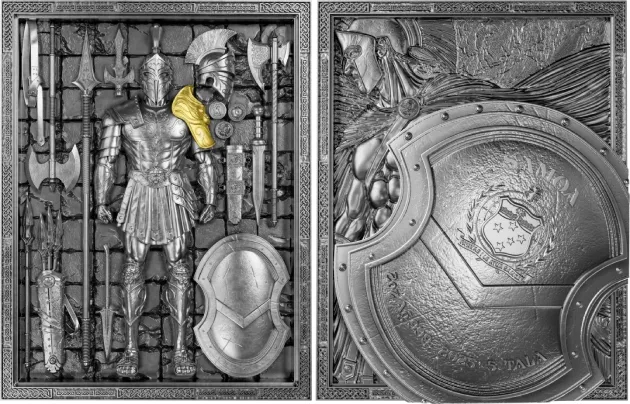
The second coin is dedicated to the world of ancient Sparta, with King Leonidas I as its central figure – known primarily for his role in the Battle of Thermopylae in 480 BC. During this conflict, the Greek army, led by Leonidas, attempted to halt the advance of the massive Persian army commanded by Xerxes I. The resistance put up by the Spartans and their allies turned this battle into one of the most significant military events of antiquity.